drums, organs, pianos,
harmonies that felt like
ghosts in the room.

Saints, Electrons and the Search for Meaning 📡
The older I get, the more mysterious the world seems.
I imagine it’s a common pattern – you arrive a helpless bundle of tears and noise, you have the world poured into you for a couple of decades, you form what you think are your principles and opinions, and then, at some point, they all start crumbling into dust.
I think it’s probably emblematic of the age in which we’re living, too.
When I was a teenager, it felt like we had most things figured out.
It was the ‘end of history’ according to Francis Fukuyama. The Soviet Union had collapsed, the internet was just beginning, and the world had been conquered by MTV and Nike and Coca-Cola.
It was a brand new millennium.
We’d all agreed that liberal democracy had prevailed and science and technology were going to solve all of our problems, and that was the end of it.
Fast-forward a couple of decades and the world feels very different.
Speaking on behalf of my own liberal democracy, the United Kingdom, things don't feel especially victorious.
It feels increasingly like a country that barely knows what it is anymore; divided by issues of economic disparity, immigration, and cultural identity.
I look across the pond and, whilst not wanting to talk for my American readers, things seem fairly crazy there too.
Consumerism and technology seem to be working in tandem to ensure that we’re simultaneously more distracted, overweight, and insecure than ever before.
And science?
The more we uncover about the nature of reality, the more confusing it becomes.
We still have no answer to the 'hard problem' of consciousness – how this physical blob of squishy matter we call a brain produces the dreamlike hallucination we all witness the world through.
We don’t know how life first sprang from non-life on Earth, and we’re yet to see any evidence for it existing anywhere else.
We don’t know how the universe began or where it came from.
Electrons, it turns out, aren’t those neat little balls of energy orbiting an atom like they told us at school.
They’re both waves and particles simultaneously, emerging from a field of probability when measured by an observer.
Whatever that means.
As Richard Feynman once said: “If you think you understand quantum mechanics, you don’t understand quantum mechanics.”
Oh, and it also seems that two electrons existing at opposite ends of the universe can somehow be ‘entangled’, such that the behaviour of one affects the other across all of space and time.
We don’t know why gravity, or the electromagnetic force, or the cosmological constant exist – but we do know that if any of them were even microscopically different, the universe would have torn itself apart at the outset.
All this leaves me more confused and disoriented than ever.
And that's before we’ve even touched on artificial intelligence, climate change, Russia, China, or the Middle East.
In short, all of that millennial confidence I grew up with seems to have utterly deserted me.
Those stories – that war was over, that liberalism and democracy had won, that science and technology would ultimately make sense of the world, that progress was our purpose – are all dissolving.
And that’s a problem, because human beings are story-telling animals.
Since the dawn of time, we’ve needed compelling stories to give our lives meaning and purpose, to bind us together in cooperative groups, to make some sense of this strange, brief existence of ours.
Traditionally, of course, we had a name for those shared stories.
We called them ‘religions’.
But then, when I was a teenager, a bloke called Richard Dawkins convinced me that they were for idiots.
And it seemed easy to believe him then.
After all, we humans seemed well on the way to figuring all of our problems out by ourselves.
But now?
If science can’t tell us why beauty moves us, or why grief hurts, what story can?
I find myself in a world where I have pretty much everything I could possibly want.
Endless entertainment, virtual gamified worlds to explore, limitless pornography, drugs, alcohol in abundance, food from every corner of the world that arrives at my door at the touch of a button.
I’ve travelled everywhere from Berlin to Beijing, and I have more degrees and certificates than I know what to do with. I’ve tried hedonism, Buddhism, rationalist materialism, and everything in between.
And yet, a lot of the time, I catch myself feeling fairly empty.
C.S. Lewis has what he calls ‘the argument from desire’.
The things human beings naturally yearn for, he says, are things that really exist.
We hunger for food because food exists; we thirst because water exists; we search for warmth, love, and sex because the world has ways for us to find them.
And, he argues, ultimate meaning – truth, purpose, God, whatever name you give it – is no different.
We desire it because it is really out there.
So I don’t quite know what to make of this new song St. Maria in light of all that.
The real St. Maria’s story is a tragic tale.
A twelve-year-old farmer’s daughter from rural Italy, she was obsessively stalked by a local man who stabbed her fourteen times when she refused to give herself to him.
She died in hospital whilst praying for his forgiveness.
Her murderer spent twenty-seven years in prison before finding God himself and becoming a lay brother in a Capuchin monastery.
And it strikes me that, somewhere in her story, the chaos and brutality of human life meets that unquenchable thirst for truth, meaning, and an ultimate justice that simply doesn't feel worldly.
And I don’t really know what all that means.
But I know that I’d like it to mean something.
Because what’s the alternative?
Keep dreaming,
Rob
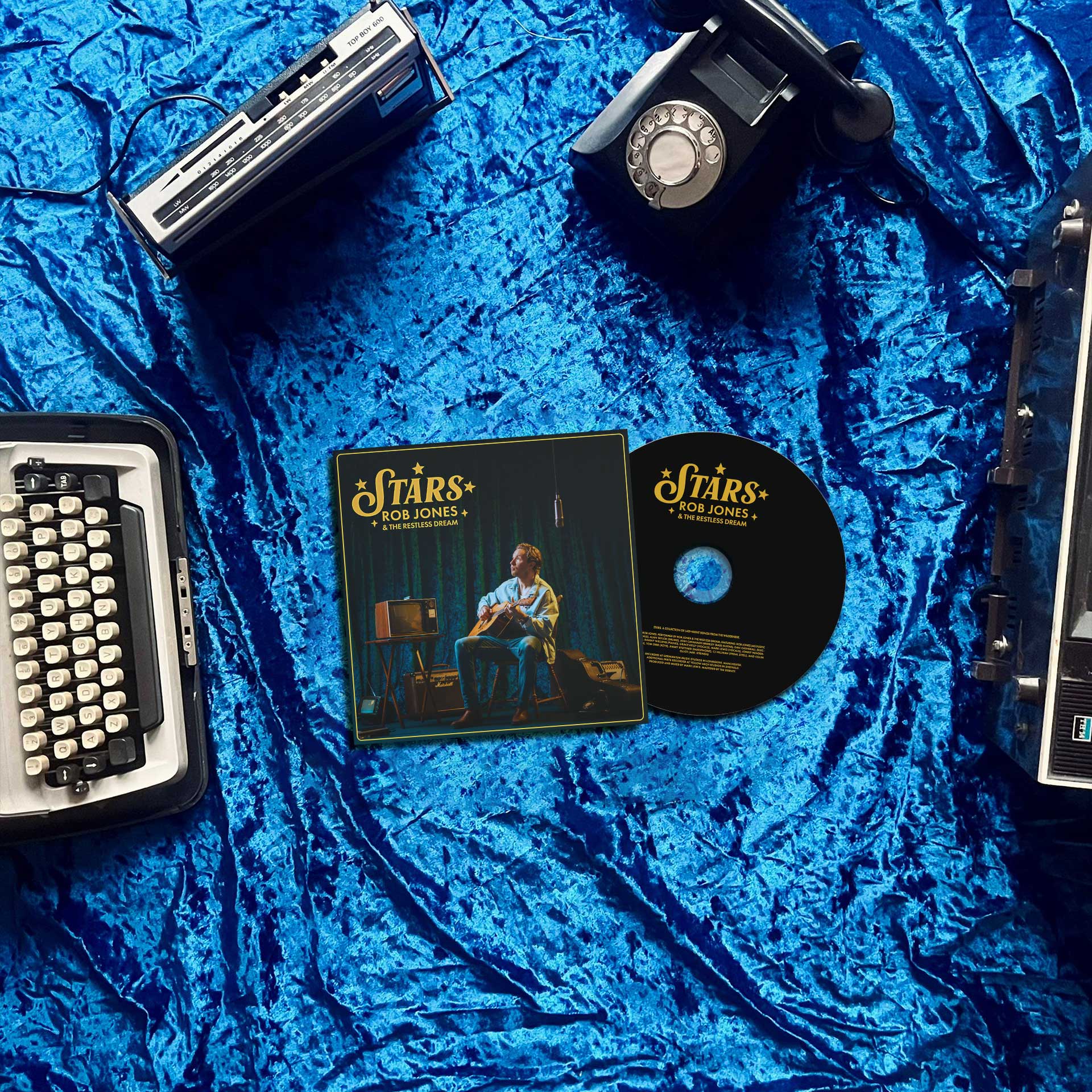
Available to buy on limited edition first run vinyl and CD